Free Trial
Added on Nov 09,2026
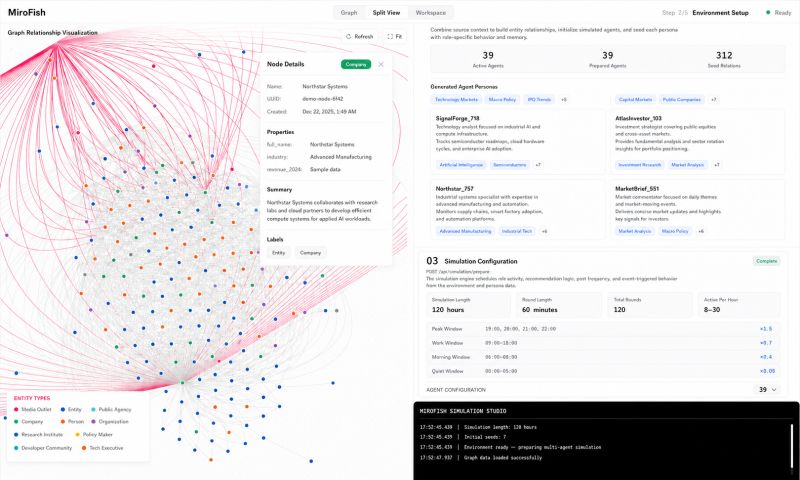
MiroFish is an AI prediction engine that uses multi-agent simulation to explore what might happen next in uncertain situations.
Users ask a question, add source material and let MiroFish handle the seed, simulation and report as one workflow. Instead of a single forecast, it builds a model of people, incentives, events, constraints and possible reactions, then tests the scenario with independent AI agents interacting in a simulated social environment.
Key features include GraphRAG, which extracts entity relationships from source material into a knowledge graph that anchors agent memory, a natural language interface for setup, and structured prediction reports with narrative analysis, group dynamics, probabilities, timeline notes and follow-up paths.
Users can inject new variables such as policy changes, market shocks or fresh assumptions and watch the simulated world recalibrate. After a run they can interview individual agents or query a ReportAgent to inspect motives and evidence, then compare branches and rerun the scenario.
Example uses include public opinion and crisis analysis, trend forecasting, scenario planning, market narrative research, policy and campaign rehearsal, sports event prediction and story-world simulation. The site is available in English, German and Brazilian Portuguese and links to the open-source MiroFish project on GitHub.
Pricing: visitors get one free simulation and signed-in users get two, with no card required. A 7-day trial adds three more simulations and then renews into Starter at 9 dollars a month. Paid monthly plans are Starter at 9 dollars (10 analyses), Pro at 29 dollars (50 analyses) and Enterprise at 59 dollars (320 analyses), with yearly billing at a discount and a one-off single analysis option.
It is suited to analysts, strategists, communications teams, researchers and writers who want to rehearse decisions before they happen.
By the PowerfulAI.tools Editorial Team · Updated 10 November 2026 · Researched with AI assistance and checked against the official MiroFish website · How we review tools
Guests get 1 one-time simulation and signed-in accounts get 2, with no card required; a 7-day trial adds 3 simulations (card required) and then renews as Starter at $9 per month unless cancelled. Starter costs $9 per month for 10 analyses, Pro $29 for 50 and Enterprise $59 for 320; yearly billing is $54, $174 and $354 a year, or a single analysis costs $2.
Pricing checked against the official MiroFish website in November 2026. Prices can change, so confirm before you buy.
PR, policy and product teams who want to rehearse how public opinion or stakeholders might react to an announcement, price change or policy before acting.
The site says MiroFish is open source under AGPL-3.0 and can be self-hosted with Docker.
No. Simulated reports are scenario explorations, not financial advice, and MiroFish itself notes that reliability depends on clear inputs, reruns and fresh outside evidence.
Popular alternatives to MiroFish include GeoSpy, Labs.Google and FigPad. Compare their pricing and what each is best for below.
| Tool | Pricing | Best for |
|---|---|---|
| GeoSpy | Contact For Pricing | Researchers, investigators and OSINT analysts who need to work out where an image was taken, using only images they have... |
| Labs.Google | Free | Developers, researchers and curious users who want to try Google's newest AI experiments before they become mainstream p... |
| FigPad | Free Trial | Researchers, academics and students who need publication-ready scientific figures without complex design software. |
| Lede | Free Trial | Freelance writers, bloggers and content marketers who want a researched first draft with sources to check. |
| Humata | Freemium | Researchers, analysts and teams who need to pull cited answers out of long PDFs and document collections. |
Own MiroFish? Add this badge to your website.

Leave a review for the community
No Review Found